


Direct vs Indirect EOR & The Question Most Buyers Never Ask

Car insurance. Energy bills. Train fares. Your Netflix subscription. The list of things that quietly gets more expensive each year no longer surprises you. You sigh, you pay, you move on.
At some point last year, your Employer of Record invoice went up, too. Enough to notice, not enough to push back on. You trust them, so you signed off.
But here's the question most companies never think to ask: does your EOR actually own the legal entity your employees are hired through? The answer is directly related to that price increase, and most providers would rather you didn’t ask.
While it might sound like a technical detail, it is one of the biggest differences between EOR operating models. And it helps explain why two companies offering what looks like the same service can have very different cost structures. Let’s take a closer look.
Why the structure behind your EOR matters
If you’ve considered the pros and cons of using an EOR for your business and decided it stacks up, you probably understand what’s on the line when international employment goes wrong: misclassification, missed obligations or contracts that don’t hold up. When things get serious, the damage lands on you.
That's why the way your EOR delivers its service matters just as much as the service itself. Two providers can offer the same outcome while operating in completely different ways. Those differences really affect both accountability and cost.
That's not a reason to distrust your EOR. But there's a difference between a provider doing their job well and a provider being structurally set up to protect your interests. The structure your EOR operates under determines how accountable they actually are, and what's sitting behind every invoice they send you.
The three EOR models
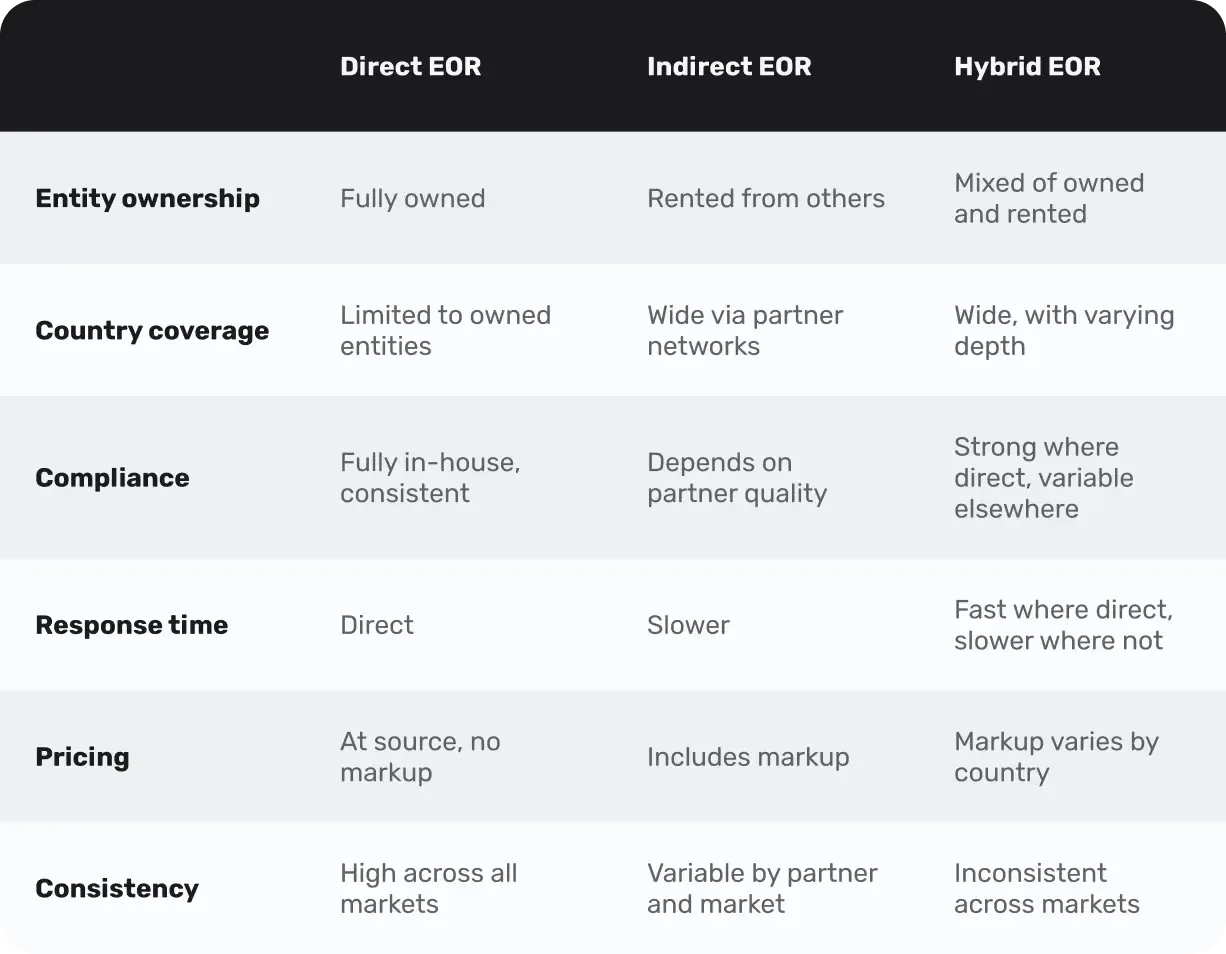
Every EOR will tell you about the benefits of using one. Far fewer will tell you about their structure. The industry runs on three distinct models, and understanding them is the starting point for knowing whether your current provider is actually working in your interest. Here's a quick side-by-side overview before we dive deeper.
Direct EOR
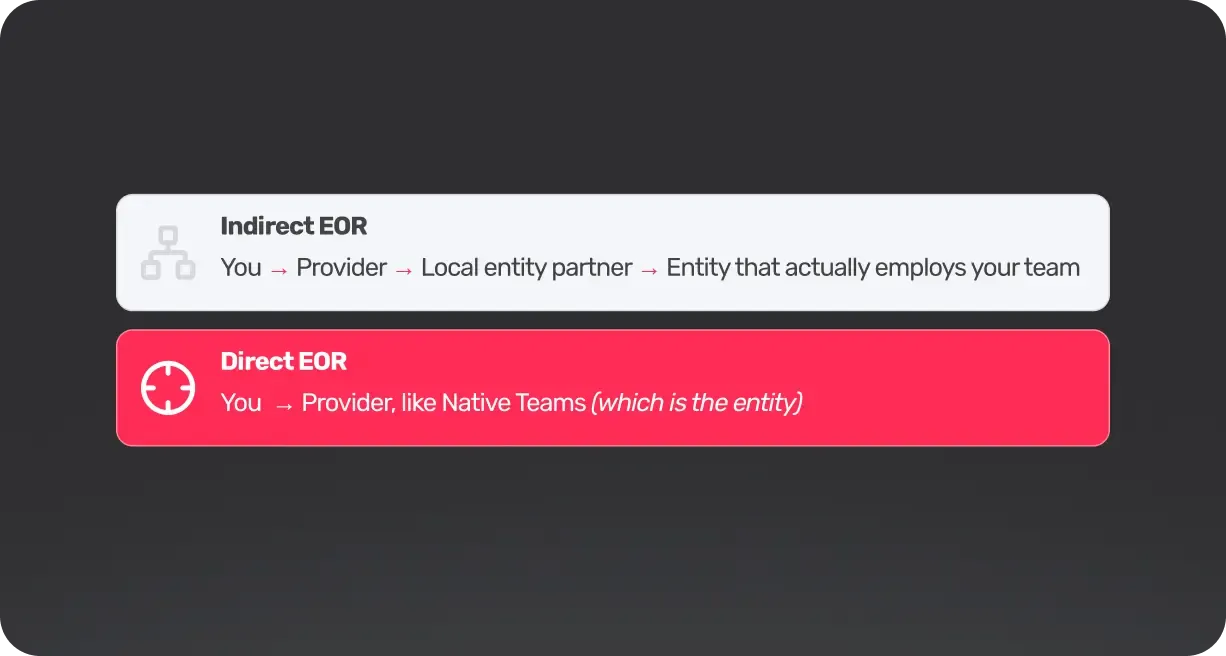
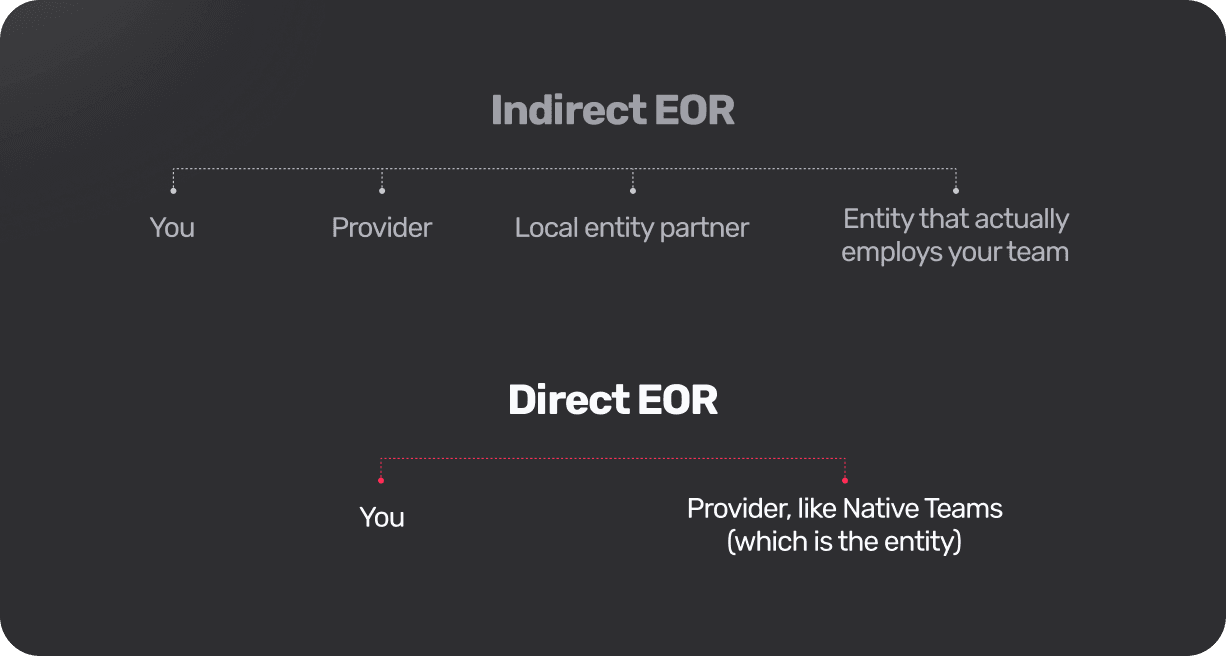
A direct EOR owns the legal entity your employee is hired through in every country it operates. No intermediary, no hand-off. They sign the contracts, run the payroll and own the compliance infrastructure entirely in-house. One organisation, one chain of accountability.
Indirect EOR
Indirect providers don't own the entities they employ through. They work with local in-country partners who do. Your EOR manages the relationship with you, while a local partner manages the actual employment on the ground. The chain runs from local partner to your EOR to you, so every link is a hand-off.
Hybrid EOR
Hybrid providers own entities in some countries and work through local partners in others. In markets where they've built their own infrastructure, the experience is closer to direct. Elsewhere, it isn't. Where your people happen to be based determines which version of the service you're actually getting.
What an indirect EOR can cost you?
Using indirect partners isn't inherently a problem. Many indirect providers deliver a reliable service, and this model can make it easier to expand into a wide range of countries. But there are two costs that rarely come up in the sales conversation.
The markup chain
Every link in the chain adds its own markup. Your EOR pays its local partner for access to the entity. Your EOR then charges you. By the time the invoice lands, you're absorbing at least one layer of markup that wasn't there before, and that cost is rarely made transparent upfront. Some providers argue that their indirect costs are comparable to those of a direct EOR for maintaining its own entities. That may hold in specific markets. But you should be able to ask for the breakdown and get a straight answer.
The handoff problem
Every compliance question, payroll issue or contract change travels the chain before it reaches someone with authority to act on it. Let’s say your employee has a problem. It goes to your EOR, who raises it with their partner, who resolves it and sends the answer back. This adds time to every interaction, and in employment matters, slow is rarely neutral. Missed payroll deadlines, delayed contract amendments, compliance questions that take days to bounce through the chain: these are the practical costs of the indirect model.
Why a direct EOR can be more cost-efficient
A direct employer of record owns its entities outright. No partner fees to pass on, no intermediary margin to absorb, no cost chain between you and the actual employment infrastructure. That's what at-source pricing means in practice. Not a promotional rate, but a structural reality.
When there's one organisation managing employment from entity to contract to payroll, the overhead is simply lower. Compliance accountability is also cleaner under a direct model. When one entity owns the relationship end-to-end, issues can be resolved more directly, helping reduce the operational costs that come with delays, duplicated effort and compliance mistakes.
One question worth asking your provider
The question is simple: Do you own the entity my employee is employed through, or do you partner with someone who does?
A direct EOR, such as Native Teams, will answer clearly and can usually tell you the name of the entity and the jurisdiction it's registered in. An indirect provider may be less specific, not necessarily because they're being evasive, but because the answer is complex. They may use different local partners across dozens of countries, with varying terms and quality.
The follow-up that matters: ask per country, not as a general question. A provider that owns entities in Germany and the UK but uses local partners in Southeast Asia is effectively indirect in those markets. Knowing which model applies where you actually hire is the question worth pressing on.
Before you renew your EOR contract
If any of this sounds familiar—costs that have crept up without explanation, slow responses to compliance queries, service that varies depending on which country you're hiring in—the structure behind your provider is worth a closer look.
It starts with one question: do you own the entity my people are hired through? Any provider should be able to answer that clearly.
Our direct EOR explainer covers what that setup looks like in practice. Or if you'd rather talk it through, book a demo and we'll walk you through it.