


8 Manager Goals Examples for Leadership & Team Growth

Every successful organisation understands that its managers are critical to connecting high-level strategy to day-to-day execution, making their personal development crucial to the business's overall health. A manager's goals are far more than administrative checklist items; they are structured, intentional pathways designed to upgrade leadership capabilities, enhance team performance, and directly impact the company’s bottom line.
This article will provide comprehensive manager goals examples across leadership development and team growth, offering a definitive guide to setting targets that genuinely drive success in today's dynamic workplace.

Why setting manager goals matters
Setting clear, measurable goals is not just a requirement of an annual review; it is fundamental for effective management and sustained organisational growth. A manager's personal objectives directly influence the morale, productivity, and professional trajectory of their entire team, creating a crucial link between individual ambition and collective success.
By deliberately establishing these targets, managers gain a clear roadmap for improving their leadership capabilities, resulting in a more focused, engaged, and high-performing workforce. This deliberate approach ensures that effort is directed towards activities that offer the highest return on investment for both the manager's career and the company's strategic vision.
The role of goal-setting in leadership success
Goal-setting provides leaders with the structure needed to move from reactive management to proactive leadership. It establishes specific benchmarks for self-improvement, compelling managers to continually assess their skills in areas such as communication, conflict resolution, and strategic planning.
A defined goal helps a manager prioritise tasks, allocate resources effectively, and measure their progress against a clear standard, transforming abstract leadership concepts into concrete actions that yield measurable results for the business.
How manager goals impact team performance
When a manager sets a goal, they create a clear standard of commitment and expectation that trickles down to the team. For instance, a manager's goal to improve feedback quality directly leads to team members receiving more actionable guidance, which, in turn, accelerates their individual development and performance. Essentially, a manager's focused effort to grow translates into a more supportive, high-accountability environment where team members feel empowered to achieve their own targets.
Using the SMART framework for effective goal planning
To ensure maximum effectiveness, manager goals should always be defined using the SMART framework. This acronym stands for specific, measurable, achievable, relevant, and time-bound.
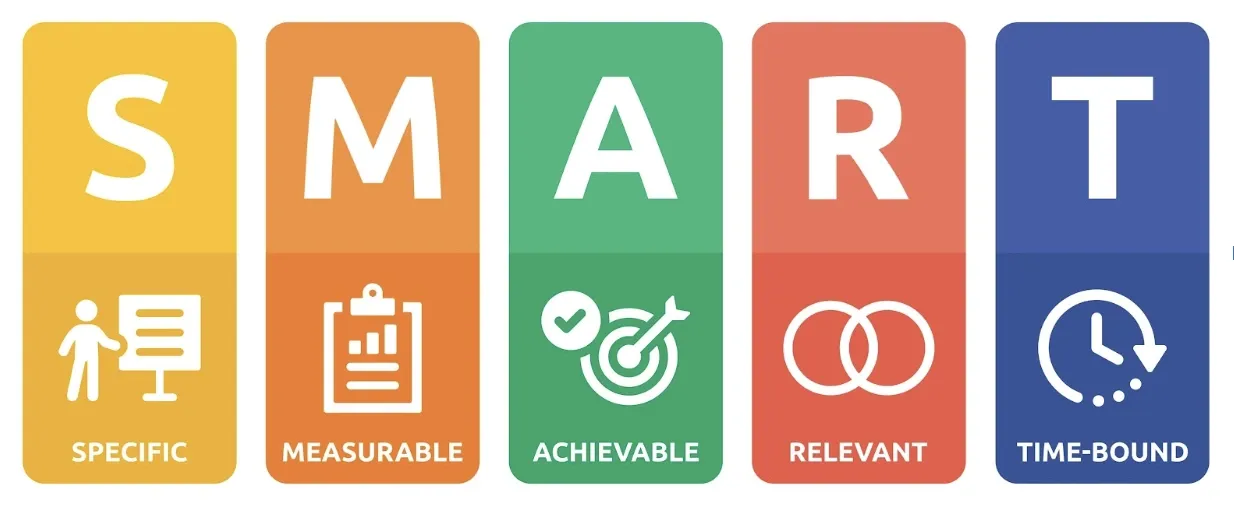
Applying this structure helps transform a vague aspiration, such as 'be a better leader,' into a concrete action plan, for example: “Increase the frequency of one-to-one coaching sessions with direct reports from monthly to bi-weekly by the end of the second quarter, evidenced by calendar entries and employee feedback scores.”
Types of manager goals
Understanding the different categories of managerial objectives is essential to creating a well-rounded, impactful development plan that addresses both immediate needs and long-term potential. Manager goals typically fall into three broad categories, each focusing on a distinct area of professional responsibility: individual performance, personal development, and overarching team strategy.
Performance goals
Performance goals relate directly to the operational success and output of the manager's team and their contribution to the company's key performance indicators (KPIs). These objectives are often quantitative and focus on achieving specific business results. Examples include targets to reduce project delivery time by 15%, improve customer satisfaction scores by ten points, or successfully launch a new product feature by a specific date.
Development goals
Development goals are centred on the manager's personal growth and the acquisition of new skills or competencies that will enhance their leadership capabilities in the long run. These are inherently focused on building future potential and addressing current skill gaps. Examples might involve completing a course in change management, gaining proficiency in a new project management tool, or improving presentation skills for executive-level communication.
Strategic and team-oriented goals
These objectives focus on high-level organisational alignment and the overall health and future direction of the team. Strategic goals tie the team's work directly into the company's overarching mission and long-term strategy, ensuring all efforts are purposeful. Examples include restructuring the department workflow to improve cross-functional efficiency, developing a clear succession plan for key team roles, or driving a measurable improvement in team engagement survey results.

Four manager goals examples for leadership growth
Managers seeking to advance their careers must focus on sharpening their leadership abilities, as these skills are crucial for motivating teams and navigating complex business challenges. True leadership growth moves beyond assigning tasks and involves cultivating a deeper capacity for emotional intelligence, clear communication, and strategic influence within the organisation.
Improve team communication and collaboration
Ineffective communication is often cited as the primary obstacle to productivity and morale. Teams waste significant time in meetings that lack focus, mixing informational updates with complex decision-making, leading to confusion and burnout. By clarifying the purpose of every team interaction, we can make collaboration more intentional and efficient. This focus will free up valuable time and ensure that discussions yield concrete outcomes, ultimately driving a more synergistic work environment.
Goal example: Implement a new standardised weekly meeting structure that clearly distinguishes between status updates, decision-making forums, and creative brainstorming sessions, reducing total meeting time by 20 minutes and tracking team satisfaction with meeting efficacy over the next quarter.
Build trust and accountability
Trust forms the cornerstone of a high-performing team; it enables individuals to take risks, admit errors, and hold each other to high standards. Consistent, high-quality feedback is the most powerful tool for building this foundation, as it demonstrates a leader's commitment to fairness and development. However, feedback must be timely and specific to be effective, avoiding vague praise or criticism. Committing to this standard ensures that every team member feels valued and clearly understands their growth path.
Goal example: Commit to delivering objective, balanced performance feedback to every direct report within 24 hours of a key project milestone, ensuring a minimum of two positive examples and one specific area for improvement are given in each instance, as verified by quarterly feedback logs.
Develop coaching and mentoring skills
The shift from being a "fixer" to being a "coach" is the hallmark of effective leadership development. By resisting the urge to provide immediate answers, leaders empower their team members to develop critical thinking and problem-solving skills independently. This approach not only builds the team’s capability but also fosters a culture of ownership and intellectual curiosity. Dedicated coaching time is an investment in long-term organisational strength, ensuring talent is developed from within.
Goal example: Spend a minimum of three dedicated, one-hour sessions each month actively coaching a team member on a specific development objective, moving away from providing direct solutions and instead using probing questions to guide them toward their own answers.
Enhance decision-making under pressure
High-stakes scenarios, characterised by limited time and ambiguous data, are the ultimate test of leadership. Without a predefined, systematic approach, the pressure can lead to panicked or inconsistent decisions, escalating an already critical situation. Developing a clear matrix provides a rational framework to fall back on, minimising cognitive load when stress is highest. Training on this system ensures that the senior team can execute a decisive, unified response, protecting the organisation from unnecessary risk.
Goal example: Document a clear, step-by-step decision-making matrix for high-pressure, low-information scenarios (e.g., an unexpected system outage) and train the senior team on its use, evidenced by the successful application of the matrix in at least one simulated exercise this fiscal half.

Four manager goals examples for team growth
The ultimate measure of a manager's success lies in their ability to cultivate and grow a successful team. Goals focused on team growth centre on creating an environment where every member feels valued, understood, and motivated to achieve their best work, leading to better collective performance and stability. These objectives go beyond mere productivity metrics, looking instead at the underlying health of the team's culture, knowledge sharing, and structural efficiency. By focusing on these manager goals examples, a manager can establish a truly sustainable and powerful unit capable of weathering challenges and delivering consistent, high-quality results for the company.
Increase employee engagement and retention
High employee engagement is directly correlated with productivity, customer satisfaction, and, critically, talent retention. When employees feel their voice is heard and valued, their commitment to the organisation deepens significantly. Initiatives that solicit and visibly act upon employee feedback create a culture of psychological safety and shared ownership. By formalising the response to suggestions, we demonstrate that their input drives real change, which is vital for keeping our top talent motivated and reducing costly turnover.
Goal example: Launch an anonymous 'idea box' initiative and commit to responding publicly to 75 per cent of all submitted suggestions within a two-week period, aiming to reduce voluntary team turnover to below the industry benchmark of 10 per cent by the end of the year.
Strengthen cross-department collaboration
Isolated operations often lead to redundant work, misunderstandings, and unnecessary conflict, ultimately hindering organisational effectiveness. Effective collaboration requires a proactive effort to bridge informational and operational gaps between teams. By creating formal opportunities for departments to understand each other's processes and priorities, we build empathy and clarity, transforming potential friction points into constructive partnerships. This transparency is crucial for streamlining complex workflows and achieving shared objectives.
Goal example: Organise and lead a minimum of two structured 'knowledge-swap' sessions per quarter with a key collaborating department (e.g., marketing or finance) to clarify mutual operational needs, with the aim of reducing inter-departmental conflict reports by 40 per cent.
Improve onboarding and training processes
The initial experience a new employee has is pivotal to their long-term success and integration into the team. A fragmented or overwhelming onboarding process can lead to early discouragement, slow productivity ramp-up, and higher attrition rates. Implementing a strong, structured programme that includes dedicated personal support, like a mentor system, drastically improves the new hire’s confidence and competence. This investment ensures that new talent is fully prepared and integrated quickly, maximising their contribution from day one.
Goal example: Redesign the team's new-starter onboarding programme to incorporate a dedicated mentor system, aiming for 90 per cent of new hires to rate their feeling of “preparedness” to perform their role at a score of four out of five or higher after their first 30 days.
Set clear KPIs and performance metrics
Vague or poorly defined key performance indicators (KPIs) are a primary source of misalignment and frustration within a team, making it impossible to measure success or allocate resources effectively and accurately. Performance metrics must be directly linked to strategic goals to ensure that all efforts move the department forward. A transparent review and communication process is essential not only for clarity but for securing team buy-in. When expectations are crystal clear and understood by everyone, accountability and focus dramatically improve.
Goal example: Review and redefine all team key performance indicators (KPIs) to ensure they are measurable and relevant to the department's strategic goals, communicating the new metrics to the team and achieving 100 per cent team sign-off on the clarity of the new expectations within six weeks.

How to track and measure manager goals
Setting ambitious manager goals is only the first step; the true work lies in developing a reliable, consistent system for tracking progress and measuring impact over time. Without a strong measurement framework, even the most well-intentioned goals can become meaningless aspirations rather than actionable targets, leading to wasted effort and missed opportunities for course correction. An effective tracking system uses a combination of qualitative feedback, quantitative data, and regular review cycles.
Using 360-degree feedback and performance reviews
360-degree feedback is an invaluable tool for a manager's goal tracking because it provides a holistic perspective on their leadership style. This involves gathering confidential feedback not just from their direct supervisor, but also from peers, direct reports, and even internal clients.
This comprehensive input helps measure qualitative goals, such as improvements in communication or trust, by quantifying the perception of their stakeholders and revealing blind spots that a manager may not recognise on their own.
Leveraging HR analytics and productivity data
For quantitative performance goals, managers should rely on data provided by HR and operational analytics. This might include tracking metrics such as project turnaround time, budget adherence, employee satisfaction scores, turnover rates, and time-to-hire. Using these objective data points allows a manager to demonstrate verifiable progress against their goals. For example, a goal to reduce team operational errors can be measured directly by reviewing quality control reports before and after process improvements are implemented.
Regular goal reviews and adjustments
Effective goal tracking is not a one-time event; it is an ongoing process that requires consistent attention. Managers should schedule bi-weekly or monthly reviews of their goals, perhaps during their one-to-one sessions with their own supervisor. These regular check-ins are crucial for assessing whether the initial plan is still relevant, identifying roadblocks, and making necessary adjustments to the strategy or timeline, ensuring the manager remains on the correct path to success.
How Native Teams helps managers lead better
For managers operating in an increasingly global and distributed working environment, the challenge of leading a high-performing team is amplified by complex administrative and compliance requirements.
Native Teams is specifically designed to alleviate these burdens, providing managers with the structural support and tools they need to focus on genuine leadership and team growth rather than getting bogged down in administrative tasks. By consolidating vital operational functions into a single, intuitive platform, Native Teams empowers managers to hire, pay, and manage talent across borders with confidence and in full legal compliance.
Tools for tracking team payments and contracts
Native Teams simplifies the administration of global workers, giving managers a single source of truth for their team's location, contracts, and payment status, which is vital for overseeing distributed teams effectively. This clarity allows managers to focus on coaching and strategic planning rather than chasing paperwork.
Manage global teams across borders
Hiring talent from outside the United Kingdom or the European Union often presents significant legal and logistical hurdles that can be prohibitive to expanding teams. Native Teams acts as an employment and global payments platform, enabling managers to legally engage, hire, and pay international talent without establishing a local entity in every country.
Simplify employment and global payments in one platform
Global growth can take many forms: hiring through Native Teams’ employment solutions, managing your own entities, or paying global teams. We’re the partner that supports you in the background while you grow with care, simplicity, and compliance. Our support system ensures that every team member, regardless of location, is paid correctly and on time, thereby reducing administrative risk and allowing managers to confidently expand their talent pool globally.

Conclusion
Setting and achieving clear manager goals is the most effective way for any leader to accelerate their professional development and significantly enhance their team's performance. By adopting the SMART framework, focusing on a balance of performance, development, and strategic objectives, and utilising effective measurement tools like 360-degree feedback, managers can create a powerful cycle of continuous improvement.
The modern global manager can further optimise this effort by leveraging platforms like Native Teams, which remove administrative friction and allow them to concentrate on genuine leadership: coaching, inspiring, and guiding their diverse talent to success.