


How Nonprofits Make Money to Pay Employees: A Full Guide

There is a common misconception that "nonprofit" means "no profit" or that the people working within these organisations are all volunteers. In reality, nonprofits are businesses with a different bottom line: impact rather than shareholder returns. To create that impact, they need professional staff, accountants, marketers, social workers, and executives, all of whom need to be paid.
So, how do nonprofits make money to pay employees? The answer lies in a diverse mix of revenue streams, strategic budgeting, and financial compliance. This guide breaks down exactly where the money comes from and how it translates into a paycheck.
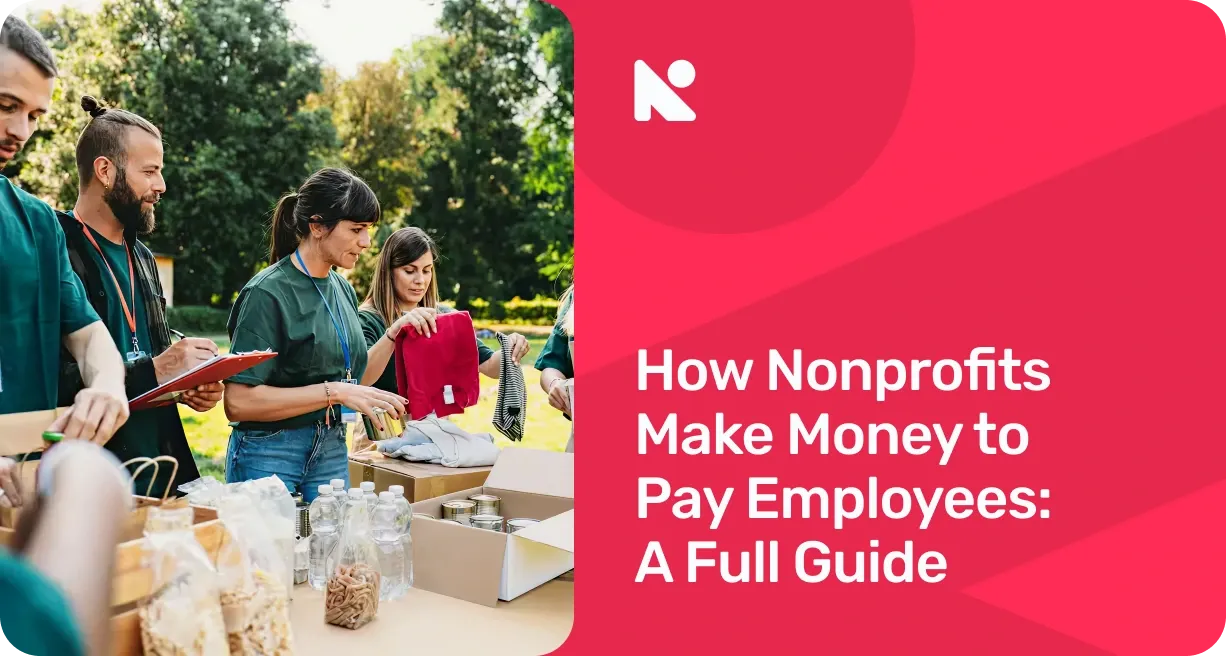
Ways nonprofits generate revenue
Unlike for-profit companies that rely almost exclusively on selling goods or services, nonprofits usually rely on a "patchwork quilt" of funding. Relying on just one source is risky, so most successful organisations diversify their income.
Grants and government funding
For many large nonprofits, grants are the financial backbone. These are large sums of money awarded by foundations (like the Gates Foundation), corporations, or federal and state governments.
- Government contracts: Many human service agencies operate almost like government contractors, paid by the state to deliver services like foster care or mental health counselling.
- Foundation grants: Private foundations award funds to nonprofits that align with their mission.
- Impact on salaries: Grants often cover the salaries of specific roles. For example, a grant might specifically pay for a "project manager" for a one-year initiative.
Donations and fundraising
This is the revenue source most people picture when they think of nonprofits. While it often makes up a smaller percentage of the budget than fees or government grants for large organisations, it is critical because it is often flexible money. This category includes:
Individual giving
These are donations from the general public, ranging from $5 to $500. While small on their own, collectively they can add up to millions. Nonprofits solicit these through direct mail appeals, email marketing, and social media campaigns like "Giving Tuesday." These funds often go into the general operating pot, making them essential for meeting regular payroll.
Major gifts
These are substantial donations from high-net-worth individuals or families. "Major" is relative to the organisation's size; it could be $1,000 for a small local food pantry or $10 million for a university. Unlike small donations, these gifts usually involve a long period of relationship building (cultivation) by development officers. Major gifts are frequently used to fund specific positions, such as endowing a "chair of research" or funding a new executive director role for three years.
Recurring donors
Also known as "sustainers," these supporters agree to donate a set amount (e.g., $20) automatically each month. While major gifts provide significant boosts, recurring donors offer stability. Knowing exactly how much money will hit the bank account on the first of the month allows nonprofit leaders to confidently budget for monthly salaries without worrying about cash flow gaps.
Events:
From black-tie galas and silent auctions to 5K charity runs and golf tournaments, events serve a dual purpose: raising money and raising awareness. Revenue comes from ticket sales, sponsorships, and auction items. However, events are labour-intensive; the "net" revenue (money left over after paying for catering, venues, and event staff) is what actually goes toward the organisation's wider payroll.
Membership fees
Many nonprofits operate on a membership model. Think of museums, zoos, trade associations, or public radio stations. Members pay an annual fee in exchange for specific benefits, such as free entry, newsletters, or voting rights within the organisation. These fees are generally considered "unrestricted" revenue, meaning they can be easily used to cover administrative salaries.

Program service revenue
This is frequently the most overlooked source of income, yet for the nonprofit sector as a whole, it is actually the most significant revenue stream. Many people assume nonprofits give everything away for free, but in reality, most operate on a "fee-for-service" model, charging clients, customers, or insurance companies for their work. This is often referred to as "earned income."
This revenue is directly tied to the organisation's mission and includes:
- Healthcare: Nonprofit hospitals and clinics bill private insurance, Medicare, and Medicaid for procedures and check-ups. This revenue is massive and is the primary source of funding for doctors' and nurses' salaries.
- Education: Private schools and universities charge tuition, room, and board. These fees cover the immense payroll costs of professors, facility managers, and administrative support.
- Arts and culture: Community theatres, museums, and symphonies sell tickets, charge admission fees, and run gift shops. While these fees rarely cover the entire cost of the production, they provide the base funding for actors, curators, and stagehands.
- Social enterprise: Some nonprofits operate businesses specifically to fund their mission. For example, Goodwill and the Salvation Army run thrift stores. The revenue from selling donated clothes doesn't go into an owner's pocket; it pays the staff to run the store and funds job training programs for the community.
The "sliding scale" difference: Unlike for-profit businesses that charge to maximise profit, nonprofits often use these fees simply to recover costs. Many offer "sliding scale" fees based on income, meaning a client pays what they can afford. In these cases, the nonprofit uses donations to subsidise the difference between the low fee paid by the client and the actual cost of the employee's time.
Sponsorships and partnerships
Corporate sponsorships are distinct from standard donations. A donation is a gift; a sponsorship is a business transaction. Corporations
pay nonprofits in exchange for marketing exposure, logo placement, or access to the nonprofit’s audience.
For example, a bank might sponsor a nonprofit's financial literacy workshop. The money received from this sponsorship is often used to pay the event planners, coordinators, and marketing staff responsible for executing the partnership.

Restricted vs unrestricted funds
If a nonprofit has $1 million in the bank, why might it struggle to pay its HR director? The answer lies in the difference between restricted and unrestricted funds.
- Restricted funds: Money given by a donor for a specific purpose. If a donor gives $50,000 specifically to buy new computers for a school, that money cannot be used to pay the janitor's salary. It is legally bound to the restricted purpose.
- Unrestricted funds: Money given with no strings attached (usually through general donations, membership fees, or service revenue). This is the "gold" of nonprofit finance because it pays for the overhead; the lights, the rent, and the administrative salaries that keep the organisation running.
How nonprofits budget for salaries
Nonprofit budgeting is more complex than simply listing income and expenses. When budgeting for payroll, accountants must allocate every dollar of salary into one of three "functional expense" buckets.
This isn't just for internal organisation; it is a requirement for tax reporting (IRS form 990) and is heavily scrutinised by donors who want to know how much of their money goes directly to the cause versus overhead.
- Program expenses: This is the most critical bucket. It includes costs and salaries directly related to delivering the mission.
- Examples: The salary of a nurse in a clinic, a teacher in a literacy program, or a social worker carrying a caseload.
- Note: This can also include a portion of a manager's salary if they are supervising these direct services. Nonprofits aim to keep this percentage high (typically above 75%) to show efficiency to donors.
- Management and general (admin): Often referred to as "overhead," these costs are required to keep the business legal, operational, and organised.
- Examples: The salaries of the CEO, HR director, receptionists, and accounting staff.
- Challenge: This is often the hardest category to fund. Many grants specifically exclude "admin costs," forcing nonprofits to use their limited unrestricted funds to pay these essential employees.
- Fundraising: These are the costs incurred to generate income.
- Examples: The salary of a grant writer, a principal gifts officer, or the event planner for the annual gala.
- Perspective: While necessary, high fundraising costs can look alarming to watchdogs. However, innovative nonprofits view these salaries as an investment; spending $60,000 on a grant writer is worth it if they bring in $600,000 in revenue.
The complexity of "split time": In many nonprofits, employees wear multiple hats. A common budgeting challenge is allocating a single person's salary across these three buckets based on how they actually spend their time.
- Example: An Executive Director might spend 20% of their time meeting with donors (fundraising), 40% of their time overseeing the clinic's strategic direction (program), and 40% of their time handling board meetings and finances (management). To stay compliant, the nonprofit must track these hours and split the funding sources for their paycheck accordingly.

Nonprofit payroll compliance requirements
Nonprofits are subject to strict scrutiny regarding how they pay their employees.
- IRS form 990: In the US, nonprofits must file this public tax document annually. It lists the salaries of the organisation’s highest-paid employees, key employees, and directors. This transparency ensures that salaries are not excessive.
- Reasonable compensation: The IRS requires that nonprofit salaries be reasonable, meaning they must align with what similar organisations pay for similar roles. If a nonprofit overpays an executive significantly above the market rate, it risks losing its tax-exempt status.
Can nonprofits pay market-rate salaries?
Yes, and they often should. The "poverty vow" mentality (that nonprofit workers should work for peanuts) is outdated and harmful. To attract top talent (skilled surgeons for hospitals, savvy investment officers for endowments, or experienced software engineers for tech nonprofits), organisations must offer competitive wages.
However, typically, nonprofit salaries are slightly lower than those in the corporate sector, often balanced by:
- Better benefits packages.
- Greater work-life balance.
- The intrinsic value of mission-driven work.
Best practices for sustainable funding
Payroll is the one expense a nonprofit cannot defer. While a vendor payment might be pushed back a week, employees expect, and legally deserve, to be paid on time. To ensure they can meet this obligation every two weeks without fail, successful nonprofits follow these rigorous financial habits:
- Diversification of revenue: Just as a smart investor wouldn't put all their money into a single stock, an innovative nonprofit never relies on a single donor or grant for more than 20% of its budget. If an organisation relies on 90% of its funding from government grants, a change in political administration could wipe out its entire payroll overnight. By balancing individual donations, earned income, and grants, they ensure that if one stream dries up, the others can sustain the staff.
- Building operating reserves: This is essentially a corporate "rainy day fund." Nonprofits aim to keep three to six months of operating expenses in liquid cash. This is critical because nonprofit income is often seasonal, receiving massive influxes in December but very little in July. Since payroll costs are flat year-round, these reserves act as a bridge, allowing the organisation to pay staff during "dry" fundraising months without taking out loans.
- Focus on unrestricted giving: Novice fundraisers ask for money to buy "things" (e.g., books, potential food, or medical supplies). Expert fundraisers ask for "general operating support." They prioritise campaigns that feed the unrestricted fund, educating donors that paying the electricity bill and the accountant’s salary are just as mission-critical as buying the supplies. This flexibility allows leadership to allocate funds exactly where they are needed most, rather than having money trapped in a restricted account while the payroll account runs low.
- Full cost recovery in grants: When applying for project grants, savvy nonprofits calculate the "true cost" of the program. They don't just ask for the materials needed; they calculate the percentage of the executive director's time, the HR software costs, and the office rent required to support that project, and build those "indirect costs" into the ask.

Conclusion
Nonprofits make money to pay employees through a sophisticated blend of earned income, charitable contributions, and government support. While they do not exist to generate a profit for owners, they must create a surplus to ensure stability. By managing restricted and unrestricted funds carefully and diversifying revenue, nonprofits ensure that the people doing the world-changing work are compensated fairly for their expertise.